Pet Health Monitoring: From Hardware to Outcomes
The pet health monitoring market is projected to hit $6.65 billion by 2031, but most companies in this space are still losing money. The hardware is commoditized. The real opportunity, and the real challenge, lies in turning sensor data into clinical outcomes that vets trust and insurers price.

Maven raised $4.42 million in September 2024 to build AI-Vet — not a better collar, but an AI platform that alerts veterinarians when something's wrong. That funding decision tells you everything about where pet health monitoring is headed.
The market is projected to hit $6.65 billion by 2031, with the health and diagnostics segment growing at 15% annually — outpacing the broader wearables category. The hardware works. Activity sensors, heart rate monitors, temperature tracking, behavior analysis — all solved problems from an engineering standpoint.
But here's what the market projections miss: most companies in this space are still losing money. The hardware is a commodity. The moat, if there is one, lives somewhere else entirely.
The companies that will win pet health monitoring aren't building better sensors. They're building the infrastructure that turns sensor data into clinical outcomes — outcomes that vets trust, insurers price, and owners pay for. That transition from hardware to outcomes is the real business problem. And almost nobody is solving it.
The Hardware Is Solved — So What?
Pet health monitoring devices have reached a point of functional maturity. The sensors work. Accuracy benchmarks hover around 92% for key vitals in well-designed systems. You can track heart rate, respiration, temperature, activity levels, sleep patterns, and position — all from a collar or harness that costs under $150.
The market reflects this progress. Smart collars account for 63.55% of the pet wearables market. North America represents 41-42% of global market share. And the health monitoring segment specifically is growing faster than GPS-only trackers — 15%+ CAGR versus 8-14% for the broader category.
On paper, this looks like a solved category ready for scale. In practice, the companies building these devices face a fundamental strategic question: what creates defensible value when anyone can source the same sensors, partner with the same contract manufacturers, and ship a competing product in 18 months?
The answer isn't better hardware. The companies treating health monitoring like a consumer electronics business — ship devices, acquire users, optimize margins — are playing a game where the floor keeps dropping. Component costs rise, retail prices can't follow, and differentiation becomes a marketing exercise rather than a structural advantage.
The real opportunity lies elsewhere: in what happens after the data is collected.
Why GPS Trackers and Health Monitors Are Different Businesses
It's tempting to lump all pet wearables together. They share supply chains, form factors, and subscription models. But GPS tracking and health monitoring are fundamentally different businesses with different value creation dynamics.
GPS tracking solves a binary problem: where is my pet? The value proposition crystallizes in moments of crisis — a lost dog, an escaped cat. Outside those moments, the device is insurance. Customers pay for peace of mind they hope never to use.
This creates a specific business model challenge we covered in our analysis of pet wearable technology: subscription resistance (nearly half of potential buyers cite recurring costs as a deterrent), hardware margin compression, and replacement cycles that prevent customer lifetime value from compounding.
Health monitoring faces different constraints. The data isn't binary — it's continuous, contextual, and ambiguous. A GPS tracker tells you where your dog is. A health monitor tells you... what, exactly? That heart rate is elevated? That activity is down 12% from last week? That sleep patterns shifted?
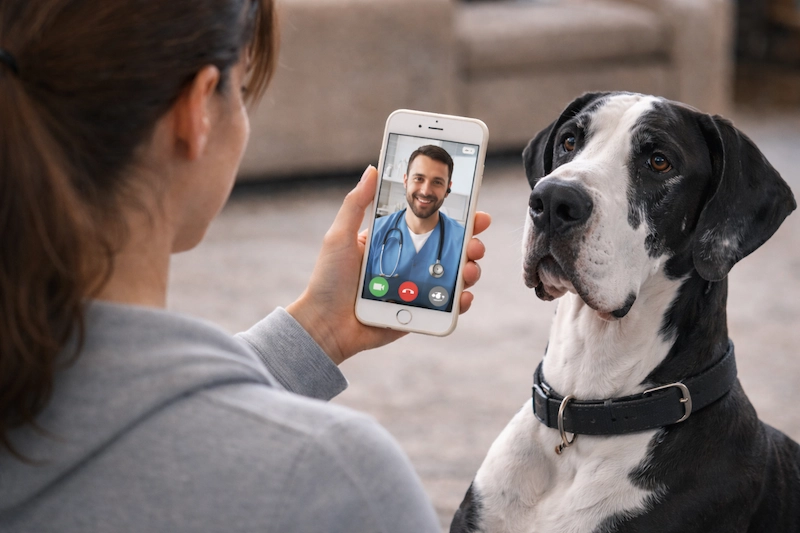
Raw biometrics aren't actionable for most pet owners. And they're not actionable for most veterinarians either — at least not yet. The value proposition isn't "know where your pet is." It's "understand what's happening with your pet's health before problems become emergencies."
That's a much harder promise to deliver. And delivering on it requires building capabilities that have nothing to do with hardware: algorithmic intelligence, clinical validation, vet integration, and ultimately, outcomes that change behavior.
The Clinical Integration Gap
Here's a number that captures the opportunity and the problem: 75% of veterinarians express interest in using wearable health data from their patients. Interest is high. Actual adoption remains negligible.
Why the gap? Pet health monitoring companies have built devices that generate data. They haven't built systems that fit into veterinary workflows, address liability concerns, or prove clinical utility.
Veterinary practice management software was not designed to ingest continuous biometric streams from consumer wearables. There's no standard API. No agreed-upon data format. No consensus on what metrics matter or how to interpret deviations from baseline. Every integration is a custom project — expensive to build, expensive to maintain, and expensive to support when it breaks.
Then there's liability. If a collar flags an abnormal reading and the vet doesn't act on it, who's responsible? If the collar misses something, who's responsible? These questions don't have clear answers yet, and veterinary practices are understandably cautious about incorporating data streams that create new vectors for malpractice exposure.
A few companies are attempting to bridge this gap. PetPace has invested heavily in clinical validation, with studies conducted at leading veterinary institutions and positioning as a "vet-grade" monitoring system rather than a consumer gadget. Maven partnered with Fear Free in November 2024, giving Fear Free Certified veterinary professionals access to its AI-powered health monitoring platform. Maven's approach embeds veterinary expertise into the product itself — the company works directly with practices, hospitals, and rehabilitation centers across the US to design features for clinical accuracy rather than consumer appeal.
But these are early moves. The clinical integration infrastructure that would make pet health monitoring genuinely useful to veterinarians — standardized data formats, proven clinical protocols, clear liability frameworks, seamless software integration — largely doesn't exist. Building it is a multi-year project that most hardware-focused companies aren't equipped or incentivized to undertake.
From Data to Decisions
The algorithmic layer matters more than the sensor layer. A collar that reports "heart rate: 95 BPM" provides information. A collar that reports "heart rate elevated 15% above your dog's typical resting baseline, combined with reduced activity, suggesting potential early signs of discomfort" provides something closer to a decision.
Building that intelligence layer requires three things that hardware companies typically lack:
Data network effects. Algorithms improve with more data from more pets across more conditions. A company monitoring 10,000 pets can build better predictive models than one monitoring 1,000. This creates a potential moat — but only if the company is structured to capture and deploy those network effects, which requires data infrastructure investments that look nothing like hardware R&D.
Species and breed specificity. A resting heart rate that's normal for a Great Dane is concerning for a Chihuahua. A baseline activity level varies dramatically by breed, age, and individual animal. Generic algorithms produce generic insights. Building breed-specific, age-adjusted, individually-calibrated models requires veterinary expertise embedded in the product team — not consulted occasionally, but integrated into the development process.
Clinical validation. Accuracy benchmarks in controlled conditions don't translate automatically to clinical utility in the real world. The gap between "this sensor measures heart rate accurately" and "this system provides insights that improve veterinary outcomes" is vast. Closing it requires clinical studies, veterinary partnerships, and the patience to build credibility through evidence rather than marketing claims.
The companies investing in this intelligence layer are making a bet: that the value in pet health monitoring accrues to whoever builds the best interpretation engine, not whoever builds the best sensor. Given that sensors are increasingly commoditized, this bet seems sound.
The Insurance and Preventive Care Angle
Pet insurance is growing faster than almost any adjacent category — the US market hit $4.7 billion in 2024, up from $3.9 billion in 2023, with projections showing 17-19% CAGR through 2033. Penetration in North America remains low, estimated at below 3%, which means the growth runway is long.
Health monitoring data could transform how pet insurance is priced and delivered. Instead of underwriting based on breed, age, and zip code, insurers could underwrite based on actual health data — rewarding pets (and owners) that demonstrate healthy baselines and early intervention patterns.
This isn't theoretical. The human health insurance market has been moving in this direction for years, with wearable data informing premiums and wellness incentives. Pet insurance follows trends from human insurance with a lag, which means the opportunity is visible even if the implementation is early.
For health monitoring companies, insurer partnerships represent a different kind of value than consumer subscriptions. An insurer that requires or incentivizes policyholders to use monitoring devices creates distribution that doesn't depend on direct-to-consumer marketing. It creates retention tied to the insurance relationship rather than the device relationship. And it creates data feedback loops that improve both the monitoring product and the insurance product.
The challenge: insurers move slowly, require significant proof of clinical value, and demand integration capabilities that most device startups can't deliver. The pet insurance market is also fragmented, with no single player dominant enough to set standards.
Still, this is where the long-term value creation likely lives. The companies positioning for insurer relationships now — building the data infrastructure, generating the clinical evidence, developing the integration capabilities — are building assets that will matter more than hardware improvements.
What Operators Should Be Watching
If you're building in pet health monitoring, investing in the category, or evaluating competitive dynamics, here's what separates signal from noise:
Vet integration traction, not interest. Everyone can cite the "75% of vets are interested" statistic. What matters is actual deployment — clinics using the data in practice, not expressing theoretical openness. Ask: how many veterinary practices are actively using this product's data in patient care? If the answer is vague or tiny, the clinical integration gap hasn't been bridged.
Clinical validation depth. Unlike human medical devices, veterinary devices don't require FDA pre-market approval — manufacturers self-certify safety and efficacy. This makes clinical validation a competitive choice, not a regulatory requirement. Companies that invest in studies at veterinary institutions, publish peer-reviewed research, and build credibility with the veterinary community are creating differentiation that pure hardware players can't easily replicate.
Data network effects. The number of active devices matters less than what the company does with the data. Is there evidence of algorithmic improvement over time? Breed-specific models? Individual baseline calibration? A company with 50,000 devices and sophisticated data science may have more defensible positioning than one with 500,000 devices and basic threshold alerts.
Subscription stickiness tied to outcomes. GPS tracker subscriptions churn when pets stay home. Health monitoring subscriptions should stick when owners see value — but that value has to be tangible. Look for evidence of outcomes: early disease detection, vet visits averted, conditions caught before they became emergencies. If the value proposition is "peace of mind" without concrete outcomes, it's a GPS tracker in health monitoring clothing.
The pet health monitoring market is real. The growth projections are plausible. But the path to building a defensible business runs through clinical integration, algorithmic intelligence, and outcomes that change behavior — not through better hardware at lower prices.
The companies that understand this distinction are building for the long game. The ones that don't are building consumer electronics in a category that won't reward commodity players.
Affiliated Products
Lorem ipsum dolor sit amet, consectetur adipiscing elit. Suspendisse varius enim in eros elementum tristique. Duis cursus, mi quis viverra ornare, eros dolor interdum nulla, ut commodo diam libero vitae erat.