
Kai Micah Mills | Founder, Cryopets
Cryopets founder and Thiel Fellow Kai Micah Mills on vitrifying pets after death, the science behind cryopreservation and revival, why 6,000 people have joined the waitlist, and why the first step toward radically extended life may start with the animals we love most.
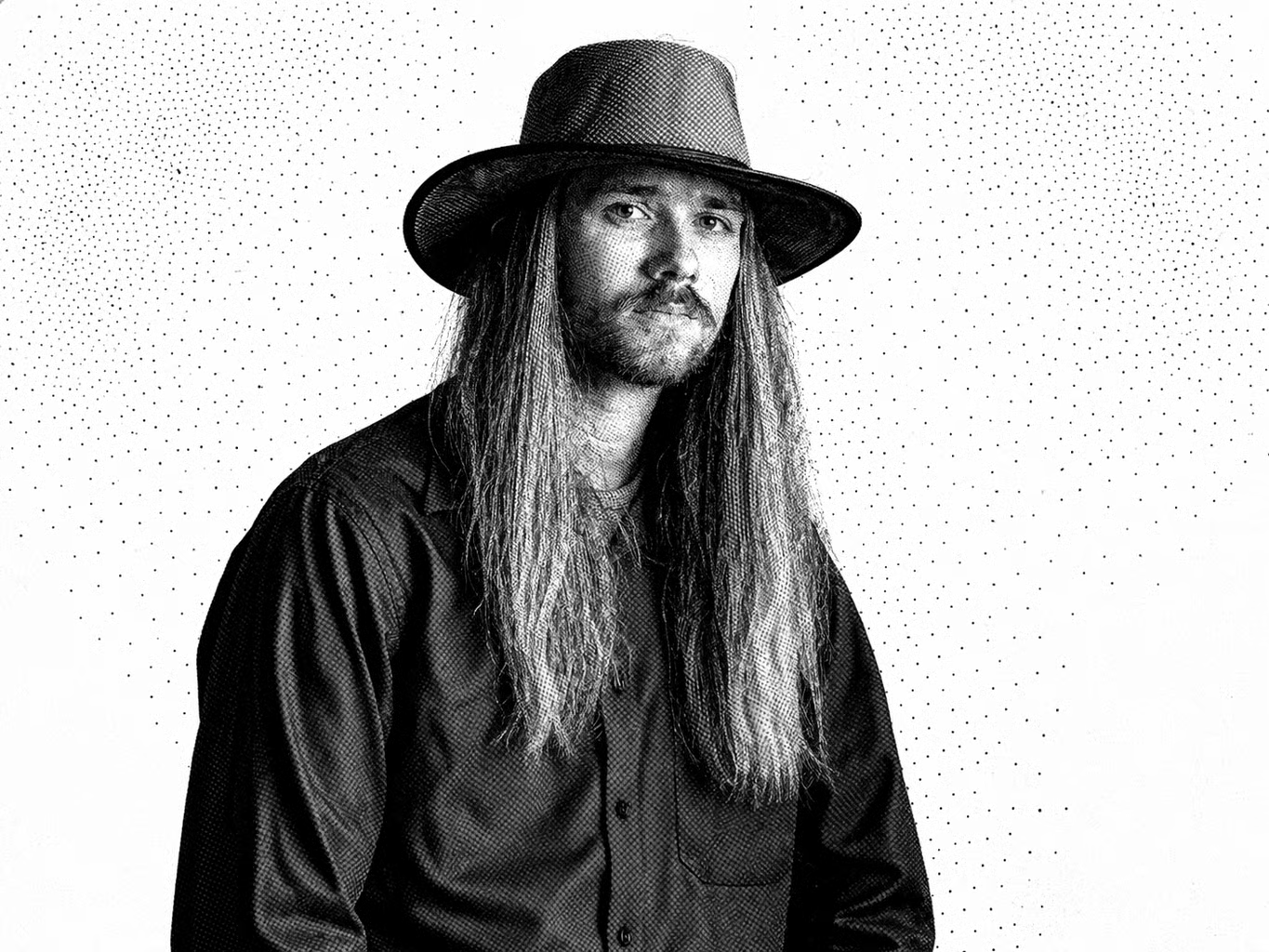
Cryonics has long lived on the fringe — dismissed as science fiction or Silicon Valley fantasy. But a new generation of founders is treating it as an engineering problem.
Kai Micah Mills, founder of Cryopets and Thiel Fellow, is building a company designed to preserve pets in a vitrified state immediately after death, with the long-term goal of revival once medicine advances far enough.
Behind the polarizing headlines is real scientific progress, serious capital, and a growing customer base that looks far more mainstream than most people would expect. In this conversation, Micah explains the breakthroughs already happening in cryopreservation, why thousands of pet owners have joined the waitlist, and why he believes the first practical step toward radically extended life may not begin with humans — but with the animals we love most.
You dropped out of high school, started building Minecraft servers, and sold your first company for six figures at just 16. What did those early experiences teach you about building companies and taking risks at such a young age?
Dropping out of high school is the single best decision I have made in my life. Minecraft was the launchpad that taught me how to be an entrepreneur. I was able to experience managing dozens of employees, thousands of customers, and large amounts of money while my peers were still in high school. Beyond just learning how to bootstrap and operate companies from scratch, I learned that isolation will force you to discover who you truly are, school is a scam, and to always, always, bet on yourself.
You've spoken about the influence the 2045 Initiative had on you. For readers who may not be familiar with it, what is the 2045 Initiative, and how did it get you interested in the world of life extension?
The 2045 Initiative was an organization founded by Dmitry Itskov, a Russian billionaire who wanted to make humanity immortal by 2045. It's where I discovered that people were working on solving death through science, and what ultimately inspired me to work toward that future myself.
You helped launch CryoDAO, a nonprofit that has raised over $10 million to fund longevity research. What kinds of breakthroughs is that community working toward right now?
CryoDAO has a considerable amount of active research. We've funded a project where we've cryopreserved entire sheep ovaries, rewarmed them, and then transplanted them back into the same sheep. Following this, we got those sheep pregnant and had baby lambs, proving the function of the ovaries.
We launched the first whole-mammal cryopreservation and revival project since the 1950s, aiming to bring a non-hibernating mammal, a rat, back from high subzero temperatures. We're also working on novel rewarming techniques, new cryoprotective agents, and much more.
You also received the $100K Thiel Fellowship. How did it help catapult Cryopet?
The Thiel Fellowship was instrumental. It's the greatest network and signal in the startup world. The most obvious benefit has been in fundraising — it helped me raise funding for a field that has historically had very little attention and capital. If there is a connection I need to make, the Thiel Fellowship has ensured that I'm always one quick intro away from opening that door.
You built your first cryonics lab in your garage. How did that come together?
I ordered our first cryogenic dewars off of eBay, our surgical table off of Craigslist, and the rest of our equipment from various parts of the Internet. At that point, it was all self-funded while I explored the field. We still use some of that equipment today!
I founded CryoDAO, our research nonprofit, around the same time, realizing that so much research was needed and funding was nowhere to be found. Building both of these organizations at the same time was key to our initial success.
I was pretty selective about when I would open my garage door in those days… after a certain point, I would only move equipment in and out at night, as it would have been a bit much for the neighbors (and my landlord!). :)
Thankfully, we have a beautiful lab and facility in Texas now and have fully moved out of the Utah garage, but I look back on those early days fondly.
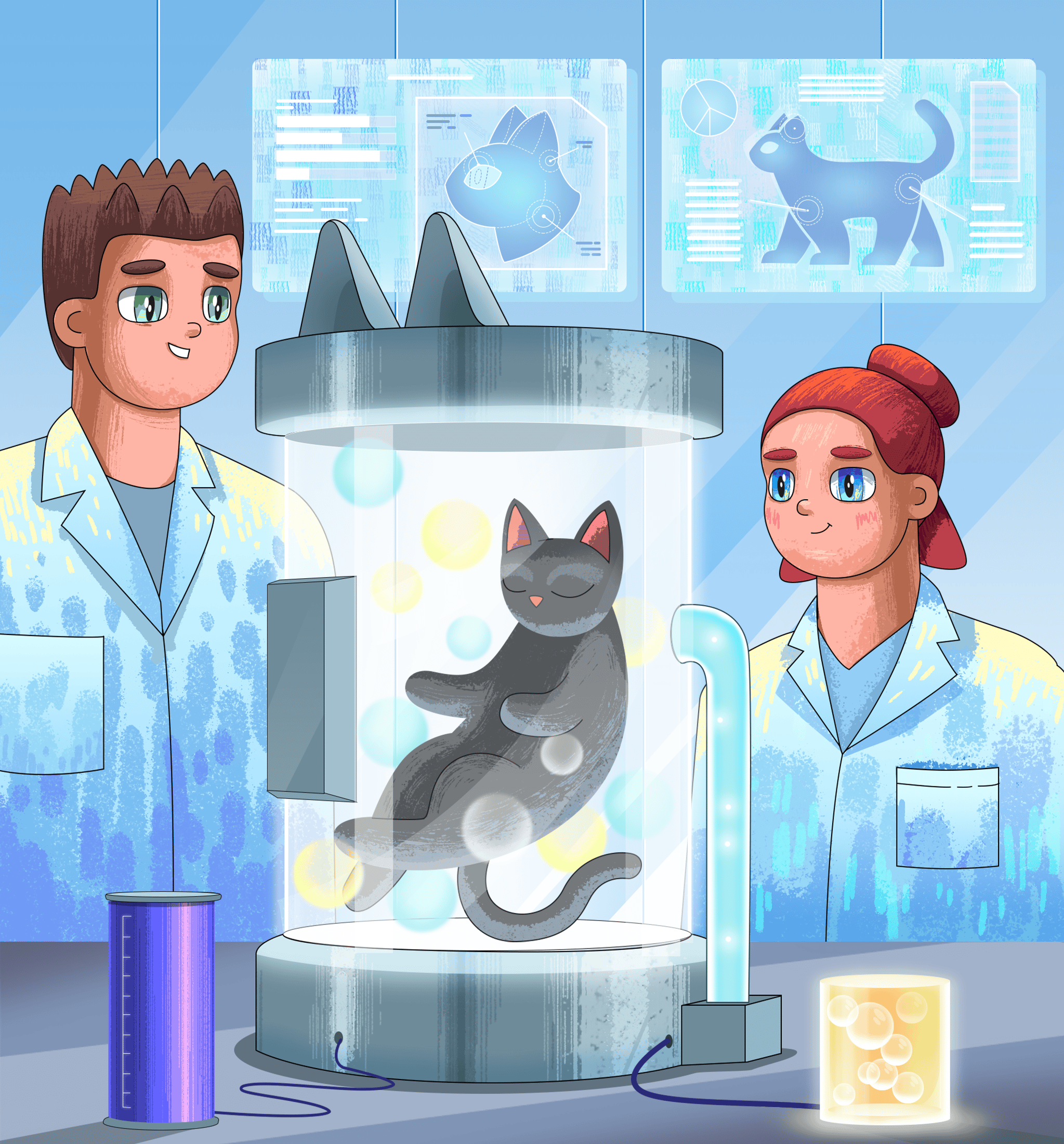
Many people hear the phrase "freezing a pet" and immediately imagine something out of science fiction. In simple terms, what is cryopet and what is the ultimate goal of the company?
"Freezing" is commonly used, and I'll even use it tongue-in-cheek, but all of the effort we put into the procedure is actually to avoid freezing. What we do is vitrify pets, turning them into a glass-like state. Entire complex organs have been vitrified, rewarmed, and then transplanted with full functionality restored. It is a proven technology — not science fiction. We work on scaling it up to whole organisms. The ultimate goal of the company is to eliminate death.
In most (or all) cases, this only happens when a dog is already scheduled for euthanization. What steps do you take to make sure the preservation process happens quickly enough to preserve the body properly?
When a pet is nearing the end of its natural life, and their veterinarian has recommended euthanasia, we schedule this with them to ensure we will be on-site when it takes place. We perform the entire cryoprotection procedure inside our ambulance, which we drive to them ahead of time, anywhere in the US. This allows us to begin to cool the body down and begin the procedure within seconds after clinical death.
You currently have around 6,000 people on a waiting list. Who are the people signing up right now — longevity enthusiasts, tech founders, everyday pet owners, or a mix?
Our most common customer is the millennial dog mom. Dogs make up 75% of the waitlist. We made a point of creating a narrative and doing our marketing to everyday people, not just to the same tech or transhumanist communities. We want this technology to be normalized. Everyone who loves their pet should be interested in what we're building, not just longevity enthusiasts.
Originally, I thought running ads wouldn't work. I was very wrong. Our videos blow up every time we post — thousands of likes, comments, and shares. It's a controversial topic, and everyone has an opinion. This brings us a tremendous amount of signups. We have dogs, cats, rabbits, hamsters, horses… even reptiles, insects, and birds. We are the modern-day Noah's Ark, and death is the flood.
How does the payment structure work for something like this? Is it a one-time fee, a membership model, or something else?
There is a subscription membership up until your pet is cryopreserved, at which point the bulk payment for the procedure and long-term storage is paid. You can also pay this over time up until that point. From then on, no further payments are necessary. We set the storage funds aside in a sort of "pet care trust" which invests safely to keep above inflation, which then covers liquid nitrogen costs indefinitely.
This not only allows pet owners to get long-term storage for their pets without having to pay for an unknown amount of time into the future, but also ensures that pets will stay cryopreserved even if Cryopets as a company fails, with the custodianship of the pets being under a separate nonprofit organization.
Preserving a body is one challenge, but reviving it is an entirely different one. When people sign up for something like this, what future are they really betting on?
They are betting on a simple truth that has always been the case: the future will be better than the past. When you zoom out enough, this is always true. Quality of life keeps improving. We discover more, we fix more, we invent more. The future they are betting on is one without disease, without aging, and without death. Cryopets acts as an ambulance ride to that future.
Other Interviews
More conversations with founders, operators, and investors building the future of pet care.
Joshua Fitzgerald | CEO, Zoomin Groomin
Joshua Fitzgerald lived Zoomin Groomin as a franchisee before running it. Now, past 300 mobile grooming vans, the CEO argues operational discipline beats flashy growth, walks through the metrics every franchisee should obsess over, and explains how the Loyalty Brands umbrella turns buying power and franchising experience into a competitive edge.
Ivan Zak | Co-Founder, Serenity Vet
After surviving burnout severe enough to nearly end his life, veterinarian Ivan Zak set out to fix the systems behind it. He bootstrapped SmartFlow and sold it to IDEXX, built the employee-owned group Galaxy Vets, and now co-leads Serenity Vet to tackle veterinary medicine's least-managed cost: labor. A candid conversation on burnout, ownership, private equity, and operational discipline.
The New Frontier of Preventive Pet Care
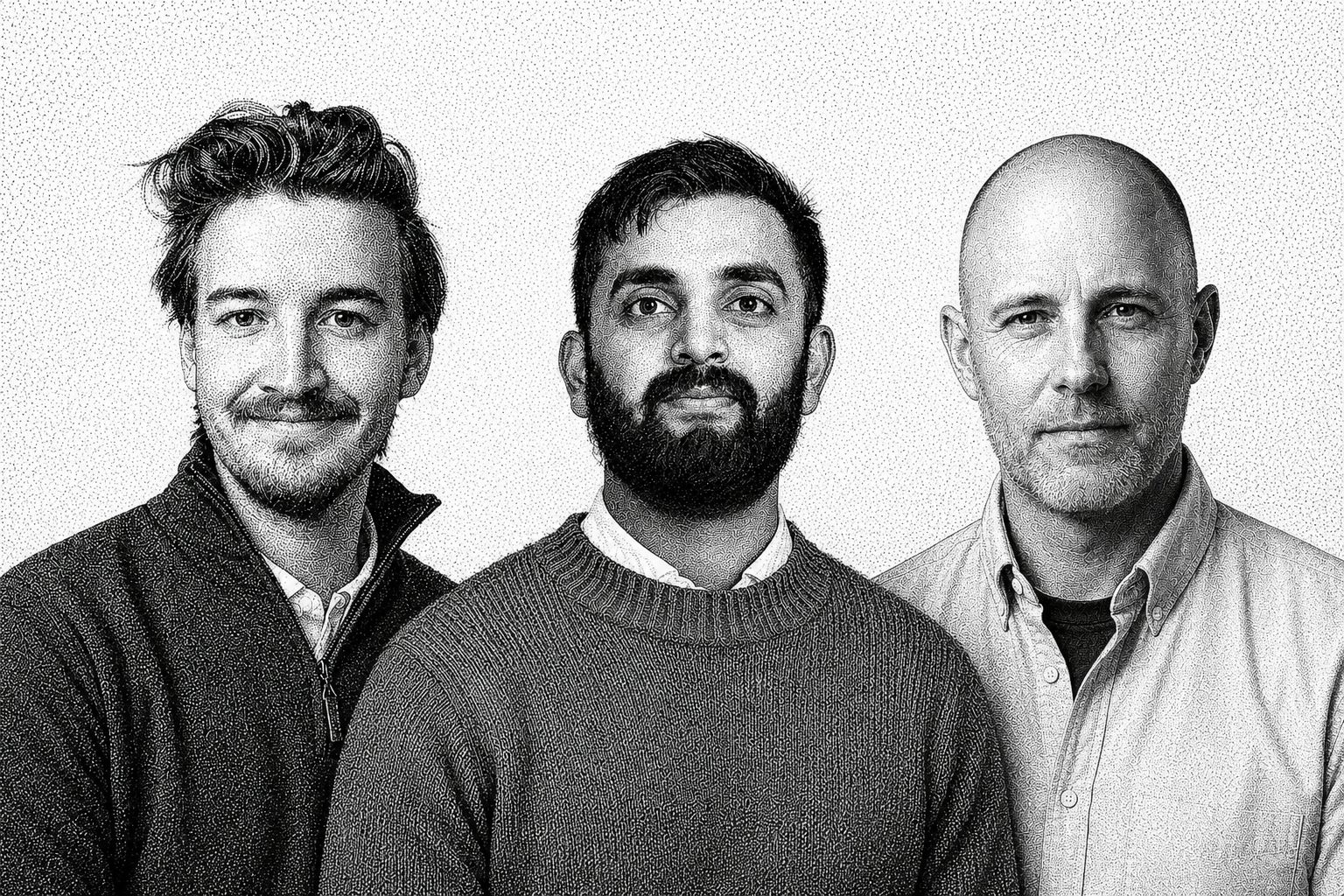
Three founders building the early-detection layer of pet health sit down with The Underbite: Rhett Rumery of Tether (wearable pain monitoring for dogs), William von der Pahlem of DeepScan Diagnostics (cell-free DNA cancer screening), and Fayzan Chaudry of Everfur (metabolomics fur testing plus a pet health app). They explain why veterinary medicine stays reactive, how long disease hides before symptoms appear, and why continuous longitudinal monitoring could move pet-care spend earlier over the next decade.