Pet Services Franchise Economics, Compared
Pet services franchising is attracting institutional talent and capital, from Petco's former CEO joining Zoom Room to VMG Partners backing Scenthound. This analysis compares the unit economics, growth models, and competitive dynamics operators need to evaluate.
Zoom Room just hired the former CEO of Petco as chairman. Camp Bow Wow launched a reduced-investment model to accelerate 2026 expansion. Dogtopia has grown unit count 80% in three years. Scenthound went from roughly 125 locations to more than 200 in twelve months and took growth-equity money from VMG Partners. The pet services franchise sector is attracting institutional talent and capital at a pace that demands a closer look at what's actually working, and what the numbers say about sustainability.
The U.S. pet industry hit $158 billion in 2025, but the fastest-growing segments aren't food or supplies. They're services: training, daycare, grooming, boarding. And franchising has become the dominant distribution strategy for scaling these businesses nationally. This article breaks down the franchise models, compares the unit economics, and evaluates what operators should understand before committing capital.
Why Pet Services Is Outpacing Product
Pet services is the structural growth story within the pet industry. While pet food grows at 3-5% annually and faces margin pressure from tariffs and private label competition, pet services is expanding at nearly double that rate.
The U.S. pet daycare market alone is projected to reach $2.85 billion by 2030, a compound annual growth rate of 8.78% from 2025. The U.S. pet grooming market is on track to hit $15.8 billion by 2029. Broader industry forecasts project 5-7% annual growth through 2030, significantly outpacing overall economic growth.
Three structural forces are driving this.
First, services are tariff-proof. With 145% tariffs on Chinese imports hammering pet toy and accessory margins, services-based businesses have zero exposure to trade policy volatility. No inventory, no import duties, no supply chain disruption. This alone is reshaping where capital flows.
Second, recurring revenue models. Daycare, training, and membership grooming franchises generate revenue through memberships, class packages, and repeat visits rather than one-time purchases. For investors and franchisees, that predictability translates to higher valuations and easier financing.
Third, the humanization premium. Pet owners increasingly treat services like daycare and grooming as non-discretionary, comparable to childcare spending. This makes services revenue more resilient during economic downturns than discretionary product purchases.
The signal that matters most: Ron Coughlin, who spent five and a half years as CEO of Petco (a $6 billion public company), chose to become chairman of a 57-location training franchise. When someone who ran one of the two largest pet retailers in America bets his next chapter on services, that's a directional indicator worth paying attention to.
The Major Models, Compared
Pet services franchising isn't monolithic. The models vary significantly in capital requirements, margin profiles, operational complexity, and growth trajectories.
Five ways into pet services, and a 30× spread in what it costs to get in.
The entry check runs from $65K for a van to $2M for a boarding facility. What you are really buying is a different risk: real estate, a trainer, a groomer, or an operating model nobody has standardized yet.
| Model | Key brands | Investment | Mature revenue | Key advantage | Key risk |
|---|---|---|---|---|---|
Daycare + boarding | Camp Bow Wow, Dogtopia | $543K–$2M | $900K–$1.5M | High recurring revenue, multiple streams | Real estate intensive, labor dependent |
Training-first | Zoom Room | $319K–$497K | $600K+ | Low investment, no inventory, high margins | Smaller revenue ceiling, trainer dependency |
Grooming — membership | Scenthound | $319K–$500K | $576KMature units | Recurring membership revenue, high visit frequency | Margin undisclosed, young system, groomer supply |
Grooming — mobile | Zoomin Groomin, Aussie Pet Mobile | $65K–$250K | $171KZoomin Groomin AUV | Lowest entry cost, no real estate | Hard revenue ceiling per van, 10% fee burden |
Multi-service hybrid | Wag N' Wash, Pet Evolution | $400K–$800K | Varies | Diversified revenue | Complex operations, harder to standardize |
SOURCE — FDD Item 7 filings for each brand. Investment ranges reflect total initial investment including franchise fees. Mature revenue reflects each brand's own most recent Item 19 or company-published figure; see the unit economics table below for per-brand attribution.
Dog Daycare and Boarding Franchise Economics
Camp Bow Wow and Dogtopia are the two dominant players in daycare-plus-boarding, and their FDD data tells a clear story.
Dogtopia operates 244 U.S. locations (205 franchised) and reported an 80% three-year unit growth rate, earning the #2 ranking in Entrepreneur's pet category for 2025. The initial investment ranges from $543,095 to $1,399,180 with a franchise fee of $40,095 to $49,500. Median yearly gross sales across the system hit approximately $905,798, with mature locations operating at 60-80% capacity generating $1M to $1.5M annually. Third-party analysts put EBITDA margins at 30-40% for mature locations, which would translate to $300K-$600K in annual profit at the top end.
Camp Bow Wow has 225 locations open or operating nationwide and closed 2025 with 14 new franchise agreements, targeting 25 in 2026. The initial investment is steeper: $1,216,577 to $2,037,471 with a $50,000 franchise fee and 7% royalty. Median gross sales across 197 reporting locations reached $988,140 in 2024. Third-party EBITDA estimates for the brand run 25-35%.
The notable development: Camp Bow Wow launched a reduced-investment model in early 2026, designed to lower the barrier for new franchisees. The details matter. If the reduced model meaningfully cuts the $1.2M+ entry point without degrading unit economics, it could accelerate the brand's growth in markets where the full-format buildout is cost-prohibitive.
Both models generate revenue from daily daycare fees ($25-$45/day), overnight boarding ($40-$75/night), and add-on services including grooming, training, and retail. The operational complexity is real: these are facility-intensive businesses requiring 5,000-15,000+ square feet of commercial space, multiple staff members per shift, and specialized insurance for animal care.
Training-First: The Zoom Room Model
Zoom Room represents a fundamentally different approach. The franchise focuses on indoor dog training with a class-based, membership-driven revenue structure. No boarding, no kennel runs, no overnight staffing.
The numbers are compelling. Initial investment ranges from $319,000 to $497,000, roughly a third of a full Camp Bow Wow buildout. System-wide average revenue per unit runs approximately $485,000. Mature stores (open at least three years) generate meaningfully more, with the company citing $184K in average net profit on its franchise website. That net margin, roughly 29% at the mature-store level, stands out in a sector where the typical franchise struggles to break 15%.
Zoom Room's advantage comes from its operating model: classes run on a fixed schedule with predictable labor costs, there's no inventory to manage, and the space requirements are smaller than daycare or boarding facilities.
The brand currently operates 57 locations across 22 states, has signed over 100 units nationwide, and is targeting 550 locations by 2030. The recent appointment of Ron Coughlin as chairman and Soumik Chatterjee as CFO (formerly of Sizzling Platter, one of the largest franchise operators in the U.S.) signals a deliberate play for institutional capital and multi-unit franchisee interest.
The execution risk: 57 open locations against 100+ signed means there's a pipeline conversion question. The gap between "signed" and "open" is where franchise development either proves itself or stalls.
Pet Grooming Franchise Economics: The Scenthound Membership Model
Scenthound is the closest thing the sector has to a pure membership play, and its Item 19 is the most granular disclosure of the group.
The brand sells routine hygiene rather than full-service styling: bath, ears, nails, and teeth, delivered on a monthly membership. Total initial investment runs $318,684 to $499,969 against a $49,900 franchise fee, with a 6% royalty plus a 1.5% ad fund, a 7.5% total fee burden. That puts it in the same capital band as Zoom Room and well below a Camp Bow Wow buildout.
The 71 reporting locations in the most recent FDD averaged $452,732 in gross revenue, with a median of $434,641 and a range running from roughly $190,000 to $924,000. That spread is the number prospective franchisees should sit with: the gap between the top and bottom of the system is nearly 5x. The 19 locations open since 2021 or earlier averaged $576,339, which says the model improves materially with age rather than plateauing after the launch marketing burns off.
Scenthound discloses no margin or profit figure, which makes it the only brand here without an earnings number. That is worth understanding correctly, because it is a choice rather than a restriction. Under the FTC Franchise Rule, a financial performance representation in Item 19 is optional. A franchisor may disclose gross sales, gross profit, net profit, or EBITDA, and many do, provided the figures have a reasonable basis and written substantiation is available to prospective franchisees on request. What a franchisor may not do is make earnings claims anywhere else, in a brochure, on a discovery call, or on a website, unless the same information appears in Item 19. The practical consequence is that most franchisors disclose revenue and stop there, because a published profit figure invites liability if franchisees underperform it. So when a brand publishes revenue at this level of granularity and no margin at all, read it as a deliberate line, not a legal wall.
Third-party aggregators model Scenthound's net margin in the 14-16% range, but that is inference from category benchmarks rather than franchisor disclosure, and operators should treat it accordingly.
The growth curve is the aggressive part. The system went from roughly 125 U.S. locations at the end of 2024 to more than 200 by October 2025, better than 60% growth, on 33 openings and 124 licenses sold during the year, with no reported closures since franchising began in December 2020. In October 2025, growth equity firm VMG Partners took a stake in the brand, and Scenthound landed at #4 on Franchise Times' 2026 Fast & Serious list.
That VMG investment is the same pattern as Coughlin at Zoom Room and Propelled Brands behind Camp Bow Wow. Three institutional capital events in pet services franchising inside a single twelve-month window is not a coincidence.
Mobile Grooming: The Volume Play
Mobile grooming is where the entry cost collapses and the revenue ceiling collapses with it.
Zoomin Groomin is the scale example. The brand reports 257 franchised units, up sharply year over year, on a total investment of $65,000 to $205,000 against a $35,000 franchise fee. That is the cheapest door into pet services franchising in this comparison by a wide margin. The tradeoff shows up in two places. Average unit volume is roughly $171,000, less than half of Scenthound's median and roughly a sixth of a Camp Bow Wow location. And the fee structure is the heaviest in the set: an 8% royalty paid weekly plus a 2% marketing contribution, a 10% total burden against revenue, where Scenthound sits at 7.5% and Zoom Room at 6%.
Aussie Pet Mobile occupies similar ground with a $100,000 to $250,000 entry and no published unit-volume figure.
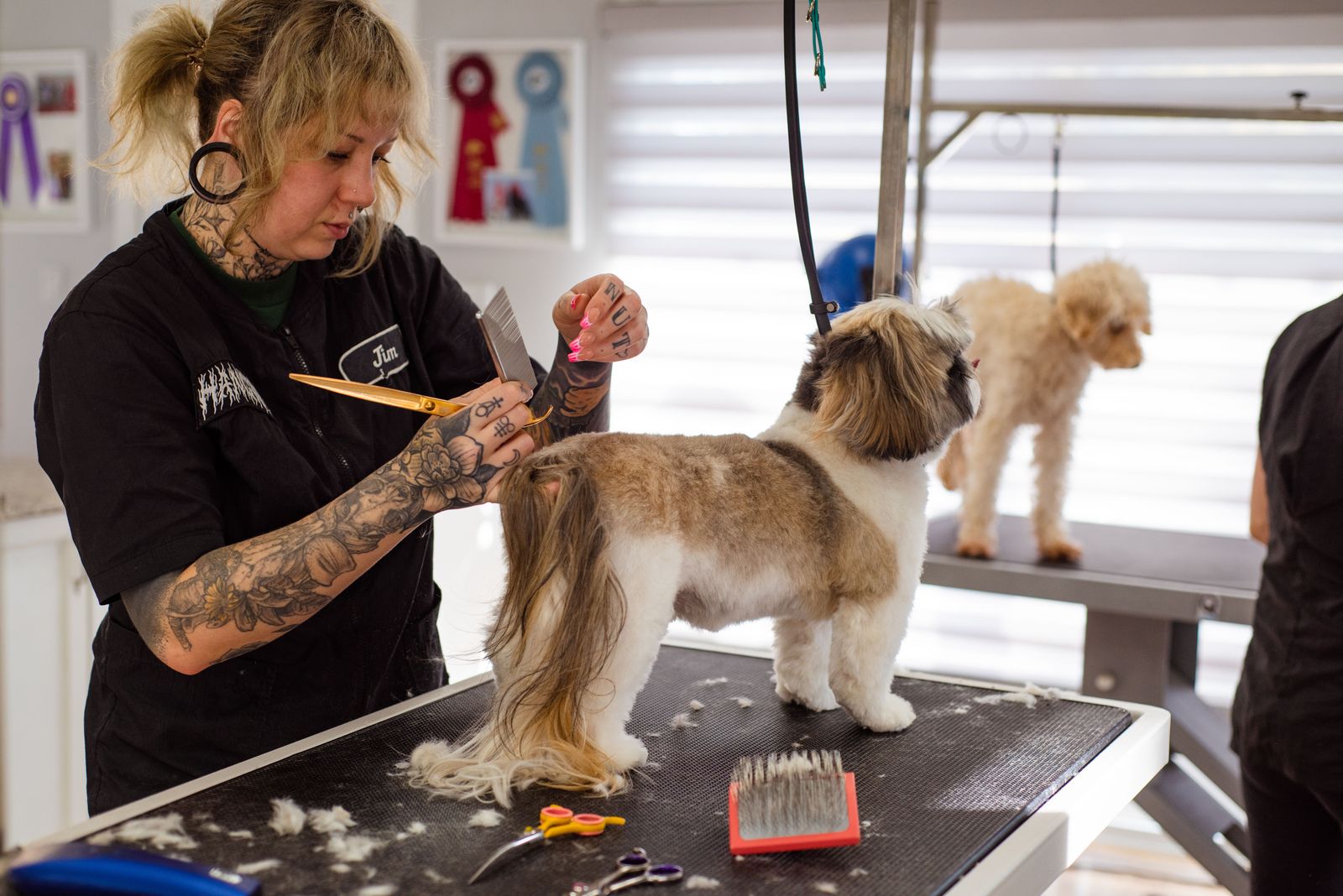
The structural constraint on every mobile model is the same. A unit is a van with one groomer in it, so revenue per unit is capped by one person's working hours, and growth means buying more vans and hiring more groomers into a national labor shortage. Fleet logistics, vehicle maintenance, and route density become the operating problem. Brick-and-mortar grooming carries higher revenue potential per location but is equally labor-constrained, and groomer retention is a persistent challenge given the physical demands of the work.
Pet Franchise Unit Economics
For operators evaluating franchise opportunities, here's what the financials actually look like side-by-side.
Line by line, the five systems disclose very different amounts about themselves.
Investment, fees, revenue, and ramp, side by side. Note where the row goes blank: two of five brands make no earnings representation at all, and the two headline EBITDA ranges are analyst estimates rather than franchisor disclosure.
| Metric | Dogtopia | Camp Bow Wow | Zoom Room | Scenthound | Zoomin Groomin |
|---|---|---|---|---|---|
| Initial investment | $543K–$1.4M | $1.2M–$2M | $319K–$497K | $319K–$500K | $65K–$205K |
| Franchise fee | $40K–$50K | $50K | $35K | $49.9K | $35K |
| Reported revenue | $906KMedian | $988KMedian | $485KAvg / $600K+ mature | $435KMedian / $576K mature | $171KAUV |
| Margins | 30–40%EBITDA † | 25–35%EBITDA † | ~29.6%Net, mature ‡ | Not disclosed | Not disclosed |
| Total fee burden | 7%Royalty | 7%Royalty | 6%Royalty | 7.5%6% + 1.5% | 10%8% + 2% |
| Locations | 244 | 225 | 57100+ signed | 200+400+ pipeline | 257 § |
| Ramp / break-even | 18–24 mo | ~24 mo | ~36 mo | 24–36 mo | Not disclosed |
SOURCE — Each brand's FDD Item 7 and Item 19 as compiled by Franchise Payback, FranchiseChatter and 1851 Franchise. † EBITDA ranges for Dogtopia and Camp Bow Wow are third-party analyst estimates, not franchisor disclosures in Item 19. ‡ Zoom Room's net profit figure is published by the franchisor on its own franchise development site. Scenthound and Zoomin Groomin make no earnings representation. § Zoomin Groomin unit counts vary by source and filing year, reported at 211 for 2025 and 257 for 2026. FDD filing years differ across brands; figures are not inflation-adjusted.
What Capital Efficiency Looks Like When You Divide It Out
The tables above are what the franchisors and the FDD aggregators publish. The number none of them print is the one an operator actually allocates against: how much annual revenue each dollar of invested capital buys. So we calculated it, using each brand's own Item 7 investment midpoint against that same brand's own reported revenue.
The cheapest franchise to open is the one that returns the most per dollar in.
Every brand's own FDD figures, run through one ratio: reported revenue divided by the midpoint of its total initial investment. Only the two lowest-capital models clear 1.19×. The two boarding boxes never get their build cost back in a single year of sales.
| Brand | Investment midpoint | Reported revenue | Revenue per $1 investedBreak-even 1.00× |
|---|---|---|---|
Zoomin GroominMobile grooming | $135,000 | $171,000AUV | 1.27× |
Zoom RoomTraining-first | $408,000 | $485,000System average | 1.19× |
ScenthoundMembership grooming | $409,327 | $452,732All-center average | 1.11× |
DogtopiaDaycare + boarding | $971,138 | $905,798Median | 0.93× |
Camp Bow WowDaycare + boarding | $1,627,024 | $988,140Median | 0.61× |
THE UNDERBITE CALCULATION — Investment midpoint is the arithmetic midpoint of each brand's own FDD Item 7 total-investment range. Revenue is that same brand's most recently reported Item 19 or company-published figure, noted per row. Each ratio compares a brand only against its own disclosures. Filing years differ across brands and figures are not inflation-adjusted, so treat the ranking as directional. Zoomin Groomin's 10% fee burden and single-groomer revenue ceiling are not visible in this metric.
Read the column and the sector's logic inverts. Camp Bow Wow, the highest-revenue concept in the comparison, is the least capital-efficient in it: every dollar invested returns about 61 cents of annual revenue. Zoomin Groomin, the smallest business by a wide margin, returns $1.27. The low-capital models are not junior versions of the big ones. They are a different trade, and the daycare premium is bought with capital rather than earned on it.
Two more things fall out of dividing the published numbers.
Maturity is worth about a quarter, and it is consistent. Scenthound's mature cohort averages $576,339 against an all-center average of $452,732, a 27.3% uplift. Zoom Room's mature stores clear $600,000 against a $485,000 system average, at least 23.7%. Two unrelated brands, two different services, and the same rough gain as units age. For anyone modeling a pro forma, that is the size of the hole a year-one projection leaves out.
The license-to-open ratio separates development from business. Zoom Room has 57 locations open against more than 100 signed, so roughly 57% of committed units are trading. Scenthound has 200-plus open in front of a 400-plus unit pipeline, around 50%, though "pipeline" and "licenses awarded" are not necessarily defined identically across brands. Sparkle Grooming Co. has crossed 600 licenses awarded while its own salon finder lists nine active locations and thirteen marked coming soon: one open unit for every 67 licenses awarded, or 1.5%. We covered that gap separately in Sparkle Grooming Hits 600 Licenses. When a brand leads with licenses sold rather than open units and same-store sales, the choice of metric is itself information.
A few other things jump out of the tables.
Ramp time is the hidden cost. Most pet services franchises take 18-36 months to reach profitability. That's 18-36 months of carrying costs (rent, labor, insurance) before the unit contributes. Franchise operators need to model this ramp period into their capitalization strategy, not just the initial buildout.
The lowest-capital storefront models cluster around $450K in revenue. Zoom Room and Scenthound both open for roughly $320K to $500K, and both land in the $435K to $485K range on system-average or median revenue. Neither reaches the $900K-plus that a daycare and boarding facility does. The tradeoff is explicit: you give up revenue ceiling to get capital efficiency and operational simplicity.
Fee burden compounds against the smallest units. Zoomin Groomin's 10% all-in take on a $171,000 average unit means roughly $17,100 a year to the franchisor, against a business with one groomer's labor capacity. Scenthound's 7.5% on a $452,732 average is about $33,955, but against more than twice the revenue base. The percentage is the headline; what it leaves behind per unit is the number that matters.
Multi-unit economics change the calculus. The real growth unlock in franchising is operators who open 5, 10, or 20+ locations. At scale, shared back-office costs, hiring infrastructure, and local brand awareness create margin advantages that single-unit operators can't access. Zoom Room's recruitment of a CFO from Sizzling Platter, a multi-unit franchise operator, is a deliberate signal to this tier of buyer.
Franchises vs. Big-Box vs. Independents
Pet services franchises don't operate in a vacuum. They compete with two other models: big-box retailer services and independent operators.
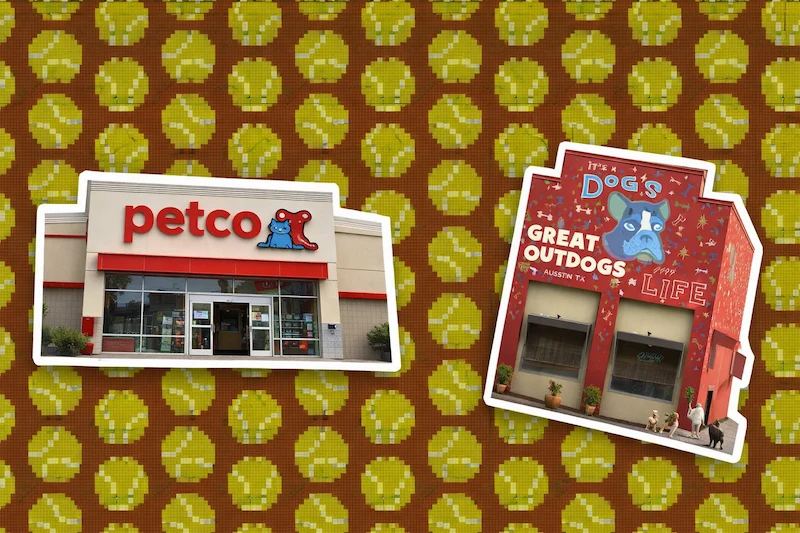
Petco and PetSmart have invested heavily in in-store services. Under Coughlin's leadership, Petco expanded its veterinary footprint from single digits to over 280 locations and more than doubled digital and services revenue. PetSmart operates the largest grooming business in the country through its retail footprint. Both chains have the real estate, foot traffic, and customer data to bundle services with product retail.
But there's a reason Coughlin left. Big-box services are constrained by their retail format: limited space allocation, competing priorities with merchandising, and a customer acquisition model built around foot traffic rather than services-first relationships. Franchise concepts like Zoom Room, Dogtopia, and Scenthound offer a dedicated experience that's difficult to replicate inside a 20,000-square-foot retail store that's primarily selling kibble and chew toys.
Independent operators represent the other end of the spectrum. The pet services market remains highly fragmented, with thousands of independent daycare, boarding, and grooming businesses operating without brand affiliation. Franchises win on brand recognition for customer acquisition, operational playbooks for consistent quality, and access to institutional capital for growth. Independents win on flexibility, local market knowledge, and lower overhead (no royalties, no brand standards compliance). On a $450,000 storefront, the 7.5% to 10% a franchisee sends upstream is $34,000 to $45,000 a year an independent keeps, which is the honest price of the playbook.
The strategic question for the sector: could Petco or PetSmart acquire a franchise concept outright? Mars, which owns VCA and Banfield, has demonstrated appetite for services platform acquisitions. A Petco acquisition of a Zoom Room or Dogtopia would combine the retail giant's customer base with a services-first operating model. The institutional talent and capital now assembling at franchise brands (Coughlin at Zoom Room, Propelled Brands backing Camp Bow Wow, VMG behind Scenthound) may be positioning these companies for exactly that kind of exit.
What This Means for Operators
For pet industry operators evaluating the franchise landscape, four considerations stand out.
Match the model to your capital and operating profile. If you have $300K-$500K and want high margins with manageable complexity, training-first and membership-grooming models like Zoom Room and Scenthound merit serious evaluation. If you have $1M+ and want higher absolute revenue with diversified streams, daycare-plus-boarding concepts offer a different risk-return profile. And if you have under $200K, mobile is the only door open, at the cost of a hard per-unit revenue ceiling. Don't chase absolute revenue at the expense of capital efficiency.
Evaluate the labor market before the franchise model. Every pet services concept is constrained by labor: groomers, trainers, daycare attendants. Before signing a franchise agreement, audit the labor market in your target geography. What are local wage rates for animal care workers? What's the applicant pool? Franchises with strong training pipelines (Zoom Room's train-the-trainer model, Dogtopia's "Canine Coach" program, Scenthound's four-week program) have a structural advantage over concepts that expect franchisees to find trained staff independently.
Model the ramp conservatively. FDD Item 19 disclosures show system averages, but averages obscure wide distributions. Scenthound's own Item 19 makes the point: a $452,732 average across 71 locations spans a range from roughly $190,000 to $924,000, a nearly 5x gap between the best and worst unit in the system. Ask for median performance, not just averages. Model your break-even at the bottom quartile, not the system average. And capitalize for 24+ months of ramp time, regardless of what the franchise sales team tells you.
Watch the multi-unit trajectory. The franchise concepts that attract multi-unit operators will grow fastest and build the strongest local market positions. If you're evaluating single-unit ownership, understand that you'll eventually compete against multi-unit operators in adjacent territories who have cost advantages you don't.
What to Watch
Zoom Room's pipeline conversion rate. The brand has 57 open locations against 100+ signed agreements. Converting signed units to open locations is the execution test. Watch quarterly opening announcements through 2026-2027.
Camp Bow Wow's reduced-investment model performance. If the lower-cost format delivers comparable unit economics, it could meaningfully expand the addressable market for daycare franchising. Early performance data should surface in the brand's 2027 FDD. The metric to check is not the new entry price but the revenue per dollar invested it produces against the full format's 0.61x.
Whether Scenthound discloses profitability. The brand publishes unusually granular revenue data and no margin data at all. With VMG capital in and a 400-unit pipeline to sell, the next FDD is the natural moment to add an earnings figure. If it doesn't appear, that silence is worth reading.
Institutional capital entering the space. Coughlin's presence at Zoom Room, Propelled Brands' backing of Camp Bow Wow, and VMG's stake in Scenthound suggest more private equity and growth equity raises are coming. Any significant capital raise would validate the services franchise thesis and likely trigger competitive responses.
Big-box services strategy. Petco and PetSmart's next moves in services, whether organic investment, partnerships, or acquisitions, will reshape competitive dynamics for every franchise operator in the space.
Groomer and trainer labor supply. The labor constraint is the sector's biggest structural risk. Any significant shift in animal care worker supply, driven by training program expansion, wage increases, or immigration policy, directly affects unit economics across every model.
Affiliated Products
Lorem ipsum dolor sit amet, consectetur adipiscing elit. Suspendisse varius enim in eros elementum tristique. Duis cursus, mi quis viverra ornare, eros dolor interdum nulla, ut commodo diam libero vitae erat.