Pet Food Formulation: What Founders Actually Need to Know
Formulation is a constraint management problem, not a creative exercise. Learn the real costs, timelines, and which decisions you make versus delegate to your formulator—before your first production run.

You're about to spend $15,000 developing a formula you don't fully understand. That's normal. But whether that $15K turns into a product on shelves — or a lesson you paid for — depends on decisions you'll make in the next 90 days.
Most first-time pet food founders get formulation wrong. Not because they hire bad formulators or choose bad ingredients. They get it wrong because they treat formulation like a creative exercise when it's actually a constraint management problem.
Here's what nobody tells you until you've already wasted a development cycle: the formulation decision isn't "what ingredients should go in my dog food." It's "who decides what ingredients go in my dog food, and what constraints do I hand them."
Get that wrong, and you'll spend six months iterating on a recipe that your co-packer can't manufacture at your target cost. Get it right, and formulation becomes the boring part — exactly as it should be.
Why Most Founders Get Formulation Wrong
The pattern looks like this: Founder has a vision. Maybe it's insect protein, or a single-ingredient line, or a recipe inspired by their dog's allergies. They find a formulator. They describe what they want. The formulator builds it.
Three months later, they discover the formula costs $4.20 per pound to manufacture — and their target retail price requires $2.80. Or the hero ingredient they built the brand around has supply chain issues and can't be sourced consistently at scale. Or the co-packer they wanted to work with doesn't have the equipment for their chosen format.
The formula worked. It just didn't work for the business.
This happens because founders approach formulation like product development in software — start with the ideal, then optimize. Pet food doesn't work that way. In pet food, you start with constraints and solve within them.
The constraints that matter:
- Price point. What's your target COGS per pound? This eliminates 80% of ingredient decisions before you start.
- Co-packer capabilities. Your manufacturer determines what's possible. A formula is worthless if nobody can make it.
- AAFCO compliance. "Complete and balanced" isn't a marketing claim — it's a regulatory requirement with specific nutrient ratios.
- Supply chain. Novel ingredients sound great until you're short 2,000 pounds of cricket meal and your production run is in three weeks.
The founders who succeed at formulation aren't the ones who create the most innovative recipes. They're the ones who hand their formulator a clear box to work within — then let the formulator solve inside that box.
Your formulator knows more about nutrient bioavailability than you ever will. Your job isn't to out-science them. Your job is to define the business problem so clearly that they can solve it.
The Three Decisions You Make (And Three You Delegate)
Here's where founders consistently overstep — or abdicate entirely.
You decide: Positioning and claims.
What story does this product tell? "Grain-free for sensitive stomachs." "Single-protein for allergies." "Sustainable insect protein for eco-conscious owners." This is your territory. Your formulator can tell you whether a claim is achievable, but not whether it's worth achieving.
The positioning decision shapes everything downstream. A "premium fresh food" positioning means refrigerated or frozen — which means specific co-packers, specific supply chains, specific price points. A "better kibble" positioning opens different doors. Make this decision before you talk to a formulator.
You decide: Price point constraints.
Your retail price determines your COGS ceiling. Work backward. If you're selling a 30-pound bag for $89.99 at a 50% retail margin, your wholesale price is ~$45. If your distributor takes 15%, you're at $38. If you need a 40% gross margin, your COGS ceiling is ~$23 — or about $0.77 per pound.
That number shapes your entire formula. Hand it to your formulator on day one. Not "we want to be premium but accessible." A number.
You decide: Hero ingredients and deal-breakers.
If your brand is built on salmon, your formulator needs to know salmon isn't negotiable. If you've promised customers no chicken byproducts, that's a constraint. But keep this list short. Every non-negotiable narrows your formulator's solution space and potentially increases your costs.
You delegate: Nutrient ratios.
AAFCO requires specific minimums and maximums for protein, fat, vitamins, and minerals. Your formulator knows these requirements cold. They know that puppies need different calcium-to-phosphorus ratios than adult dogs. They know that certain vitamin forms are more bioavailable than others. Let them handle this.
You delegate: Ingredient sourcing specifics.
You might specify "salmon as the first ingredient." Your formulator decides whether that's salmon meal, fresh salmon, or deboned salmon — based on cost, availability, and how it affects the nutritional math. They'll also know which suppliers can deliver consistent quality at your volume.
You delegate: The compliance math.
Meeting AAFCO's "complete and balanced" standard requires precise calculations. Your formulator runs these. They know which nutrients come from which ingredients, how cooking affects nutrient retention, and how to hit every requirement without overshooting costs.
The collaboration model that works: You define the box (positioning, price, must-haves). They solve within it. You review and approve. They iterate if needed.
The collaboration model that fails: You tell them exactly what to put in the food, they execute, and you discover six months later that the economics don't work.
Working With a Formulator
You have two options: use your co-packer's in-house formulator or hire an independent consultant.
Co-packer's formulator: Pros
They already know what the facility can make. They've optimized thousands of formulas for that specific equipment. They have existing supplier relationships that can reduce your costs. And it's often "free" — bundled into the co-packing relationship.
Co-packer's formulator: Cons
They're not your formulator. They work for the co-packer. Their incentive is to create formulas that run efficiently on existing equipment — which may not be what makes your product distinctive. And if you ever want to switch co-packers, your formula may not transfer cleanly.
Independent formulator: Pros
They work for you. They can design a formula that's equipment-agnostic, giving you flexibility to switch manufacturers. They often have deeper expertise in specific categories (raw, fresh, supplements) than generalist in-house teams.
Independent formulator: Cons
You're paying $3,000-$25,000 for formulation services, depending on complexity. At the low end, you get a basic formula and nutritional analysis. At the high end, you get multiple iterations, feeding trial coordination, and ongoing consultation. And you still need to verify that your formula works for whatever co-packer you choose.
What it typically costs:
- Basic formulation (single SKU, standard kibble): $3,000-$8,000
- Complex formulation (fresh/raw, novel proteins, multiple SKUs): $10,000-$20,000
- Full-service (formulation, feeding trials, regulatory coordination): $20,000-$35,000+
Note: Pricing varies significantly by consultant and scope. These ranges reflect industry estimates; get quotes from multiple providers.
Timeline expectations:
From first brief to production-ready formula, expect 3-6 months typically. This includes:
- Initial consultation and brief (Week 1-2)
- First formula draft (Week 3-6)
- Review and iteration — often 2-3 rounds (Week 7-14)
- Final nutritional analysis and documentation (Week 15-18)
- Co-packer validation (Week 19-24)
Plan for delays. Ingredient shortages, reformulation requests, and co-packer feedback all extend timelines. As Pet Food Industry notes, you can't "make the product in a week and then have it on the shelf the next week."
Red flags in formulator relationships:
- They won't share their methodology or explain their choices
- They promise unrealistic timelines ("formula in two weeks")
- They don't ask about your co-packer or manufacturing constraints
- They're unfamiliar with AAFCO requirements for your specific product type
- They can't provide references from products actually in market
The Co-Packer Relationship
Your formula doesn't exist in isolation. It exists inside a manufacturing facility, and that facility has constraints.
Formulation and manufacturing are linked.
A co-packer running extrusion equipment makes kibble. A co-packer with HPP capability makes fresh. A co-packer with freeze-drying equipment makes freeze-dried. Your formula has to work for the equipment available.
This sounds obvious. But founders regularly develop formulas without confirming a co-packer can make them. The result: expensive reformulation, or worse, a search for a different co-packer with the right capabilities and the MOQs you can meet.
Talk to co-packers before finalizing your formula. Get confirmation that they can make what you're planning. Better yet, use their in-house formulator or have your independent formulator coordinate with them directly.
MOQs and iteration realities.
Most co-packers require minimum order quantities of 5,000-20,000 pounds per SKU per run. That's not a test batch — that's production volume.
This means you can't iterate endlessly. Each "let's try a different formula" costs thousands of dollars in ingredients plus manufacturing fees. Plan to get your formula right before you commit to production runs.
Some co-packers offer development runs at smaller volumes (1,000-3,000 pounds) for new products. This costs more per pound but gives you a chance to validate before scaling.
What changes when you scale.
A formula that works at 5,000 pounds may need adjustment at 50,000 pounds. Ingredient supply becomes more complex. Minor variations in raw materials have bigger impacts. Equipment settings may need recalibration.
Build a relationship with a co-packer who will grow with you — and who has capacity for your projected volumes. Switching co-packers mid-growth is expensive and risky.
Regulatory Constraints That Shape Your Formula
You can't sell pet food that claims to be "complete and balanced" unless it actually is. AAFCO defines what that means.
AAFCO requirements (simplified):
AAFCO publishes nutrient profiles for dogs and cats at different life stages. Your formula must meet minimum levels for protein, fat, vitamins, and minerals — and stay below maximum levels for certain nutrients.
For a product to carry "complete and balanced" on the label, it must either:
- Meet AAFCO nutrient profiles through formulation (calculated method), or
- Pass feeding trials proving animals thrive on the diet
Most startups use the formulation method. It's cheaper and faster. Feeding trials require a minimum of 8 dogs over 26 weeks and can cost $50,000-$100,000+ according to industry estimates.
What your formulator handles:
Your formulator calculates whether your recipe meets AAFCO profiles. They'll provide a nutritional analysis showing compliance. This document is essential for state registration.
What you need to understand:
Different life stages have different requirements. "All life stages" is the most restrictive (must meet puppy/kitten standards). "Adult maintenance" is less demanding. Pick your claim based on your target market.
Some claims require additional substantiation. "Supports joint health" might need more than just glucosamine in the formula. Consult your formulator — or a regulatory specialist — before making functional claims.
State registration:
Pet food must be registered in each state where it's sold. Requirements vary. Some states rubber-stamp registrations; others scrutinize labels and formulas. Your formulator should provide documentation that satisfies the strictest states.
For more on navigating the regulatory landscape, see our pet food regulations guide. [PLANNED: /regulatory/pet-food-regulations]
The Mistakes That Kill First-Time Founders
Every formulation veteran has seen these patterns destroy launches.
Overcomplicating the formula.
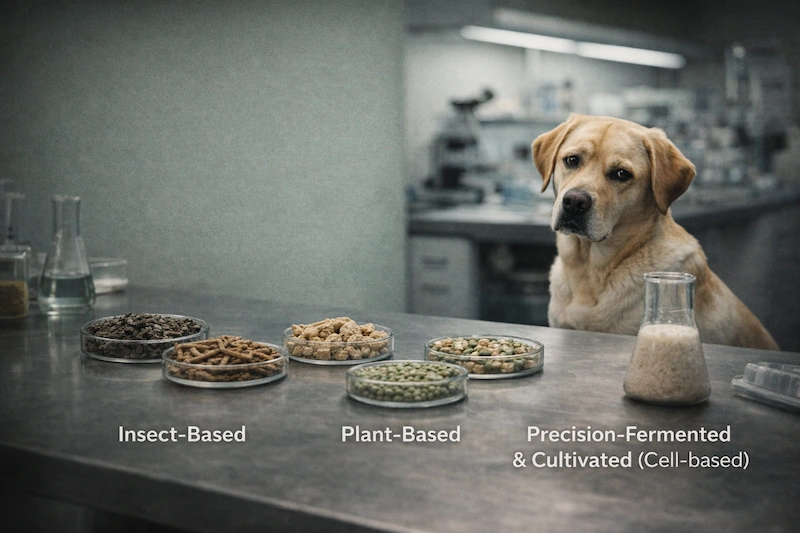
Novel ingredients sound great in pitch decks. They're nightmares in production. Insect protein, cultured meat, exotic superfoods — each introduces supply chain risk, cost volatility, and potential regulatory scrutiny.
Start simple. Prove the business with ingredients that are easy to source and manufacture. Add complexity once you have revenue and leverage with suppliers.
Underestimating iteration cycles.
Your first formula won't be your final formula. Budget time and money for 2-3 iterations minimum. If you've promised investors or retailers a launch date based on your first formula being perfect, you've set yourself up for a painful surprise.
Ignoring unit economics at formulation stage.
"We'll optimize costs later" is the sound of a business that won't survive. Your formula's ingredient cost is locked in at development. If that cost doesn't work for your business model, you need to know before you manufacture 20,000 pounds.
Build your financial model during formulation, not after. Run the numbers on every formula draft.
Not locking in ingredient supply.
Your formulator can specify salmon meal from a specific supplier. But can that supplier deliver 10,000 pounds per month? At what price? With what lead time?
Before you finalize a formula, confirm that every ingredient can be sourced at the volume, price, and consistency you need. A beautiful formula with an unreliable supply chain is worthless.
Skipping the co-packer conversation.
You developed the perfect formula. Your co-packer can't make it. Now you need to either reformulate or find a different co-packer — both expensive, both time-consuming.
The sequence that works: Positioning → Co-packer selection → Formulation (constrained by what they can make) → Production.
The sequence that fails: Positioning → Formulation → Co-packer search → Reformulation → Production.
The Path Forward
Formulation isn't where you win in pet food. Distribution, brand, and customer loyalty are where you win. Formulation is where you avoid losing.
The founders who succeed at formulation aren't the ones who create the most innovative recipes. They're the ones who create recipes they can actually manufacture at scale, at a cost that works, with ingredients they can source reliably.
Get the constraints right. Hire expertise you can trust. And spend your energy on the parts of the business that actually differentiate you.
Your dog food doesn't need to be revolutionary. It needs to be manufacturable, compliant, and profitable. Everything else is marketing.
Affiliated Products
Lorem ipsum dolor sit amet, consectetur adipiscing elit. Suspendisse varius enim in eros elementum tristique. Duis cursus, mi quis viverra ornare, eros dolor interdum nulla, ut commodo diam libero vitae erat.