Pet Supplement Formulation: Lower Barriers, Higher Margins
Pet supplements offer a faster, cheaper path to market than food—with lower MOQs and simpler regulations. The real costs, timelines, and the health claims trap that catches first-time founders.
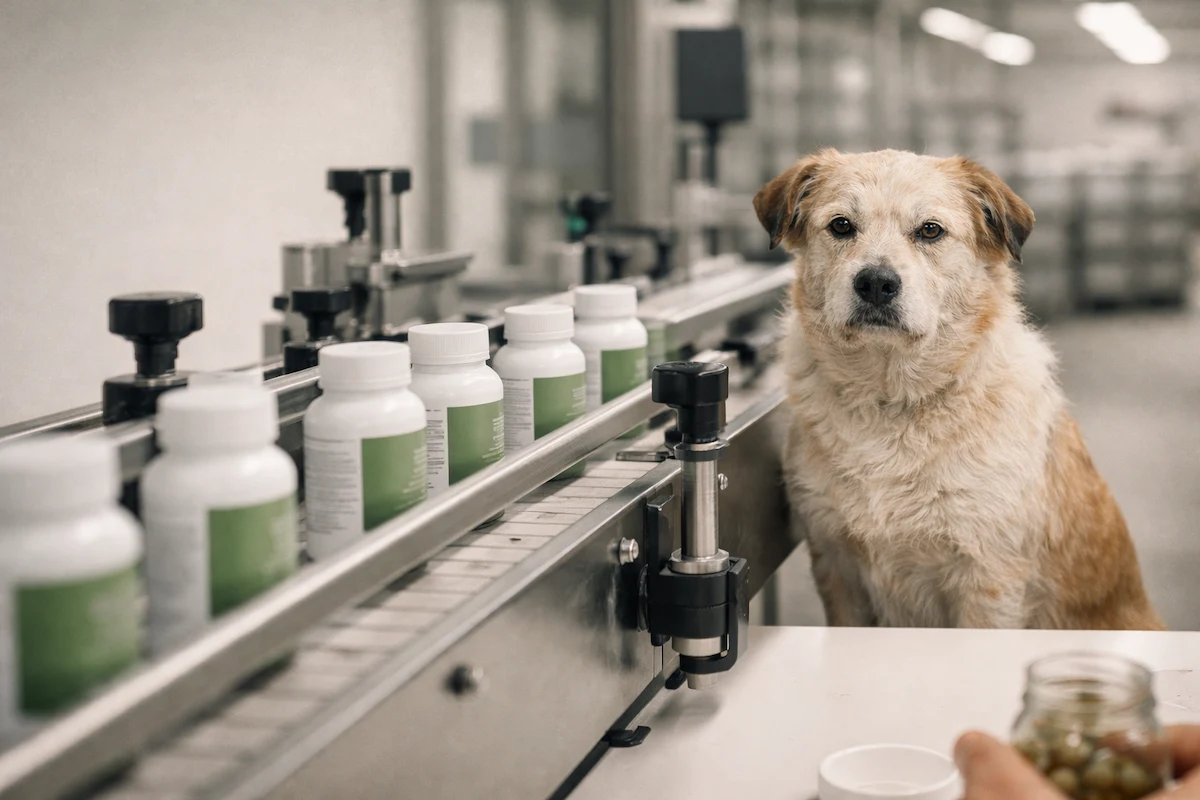
Most pet founders start with food. That's often a mistake.
Pet supplements offer a faster, cheaper path to market with higher margins and lower regulatory friction. The global pet supplement market hit $2.7 billion in 2024 and is growing at 5-8% annually. More importantly for founders: minimum order quantities start in the hundreds, not tens of thousands. You can test, iterate, and find product-market fit without betting the company on a single production run.
But supplement formulation comes with its own decision tree — one that most content ignores entirely. The industry talks to formulators and manufacturers, not founders. Here's what you actually need to know.
Why Supplements Are Often the Smarter First Product
Pet supplement formulation offers structural advantages that food can't match, especially for capital-constrained founders.
The regulatory bar is lower. The FDA regulates pet supplements as "animal feed" under the Federal Food, Drug, and Cosmetic Act — not the stricter standards applied to human dietary supplements. There's no pre-market approval required. You're responsible for safety and accurate labeling, but you don't need FDA sign-off before you sell.
The economics work better at small scale. While pet food manufacturers typically require 10,000+ unit MOQs, supplement manufacturers will often work with 500-800 units for soft chews or 2,500 units for powders and liquids. That's the difference between a $50,000 bet and a $5,000 test.
Margins are healthier. Supplements command premium pricing relative to their production costs. A hip and joint chew that costs $0.15 to produce can retail for $1.50 — margins that give you room to acquire customers profitably while food brands fight over pennies.
The hip and joint segment alone generated $2.1 billion in 2024, representing over 32% of the market. Probiotics account for 38% of market share. These aren't niche categories — they're large markets with room for differentiated brands.
None of this means supplements are easy. But they're often the smarter first move, especially if you're testing a brand thesis before committing to the complexity of food manufacturing.
The Decision That Shapes Everything Else
Pet supplement formulation forks early: custom development or private label. This choice determines your timeline, budget, differentiation potential, and relationship with manufacturers.
Private label means using an existing formula from a manufacturer's catalog. You're essentially white-labeling a proven product under your brand. The advantages are speed and cost — you can launch in roughly 90 days with total costs of $5,000-$15,000 including formulation, labeling, and initial production. The tradeoff is differentiation. Your formula is available to other brands. You're competing on brand, marketing, and distribution — not product uniqueness.
Custom formulation means developing your own proprietary formula. Development costs run $5,000-$15,000+ for the formula alone, with additional costs for R&D, pilot batches, and stability testing. Timeline extends to 8-12 weeks or longer depending on complexity. The advantage is genuine differentiation — a formula competitors can't simply copy.
The right choice depends on your strategy. If you're testing market demand, validating a brand position, or moving fast on limited capital, private label makes sense. If your entire value proposition rests on a novel formulation — a unique ingredient combination, a delivery mechanism, a specific efficacy claim backed by research — custom development is necessary.
Many founders take a hybrid approach: launch with private label to prove demand, generate revenue, and learn customer preferences, then invest in custom formulation for hero products once the business model is validated. This sequences risk appropriately.
For context on how supplement formulation decisions connect to broader product development, see our guide to pet food formulation — many of the strategic principles apply across categories.
The Real Numbers
Pet supplement formulation costs follow a predictable structure, but the ranges are wide enough that budgeting without specifics is dangerous.
Formula development:
- R&D and pilot batch fees: $300-$2,500 for simpler formulations
- Custom formula development: $5,000-$15,000+ depending on complexity
- Private label formulas: $5,000-$15,000 total (formula + initial production)
Production minimums by format:
FormatTypical MOQNotesSoft chews500-800 unitsLowest barrier to entryPowders2,500 bottlesPer flavor/SKULiquids2,500-10,000 unitsHigher variance by manufacturer
Compliance costs:
- Label design and FDA compliance review: $500-$2,000
- Certifications vary by program and scope
Hidden costs to budget for:
- Stability testing (required for shelf-life claims)
- Certificates of Analysis for each ingredient batch
- Custom tooling for specific product formats
- State registration fees where applicable
The total cost to launch a basic supplement line runs $10,000-$30,000 depending on approach. Custom formulation with multiple SKUs can exceed $50,000 before you've sold a single unit. Budget accordingly.
How Long This Actually Takes
Pet supplement formulation timelines range from 90 days to 6+ months depending on your approach and how many decisions you've already made.
The accelerated path (cataloged formulas): Roughly 90 days from manufacturer selection to finished product. This assumes you're choosing from existing formulas, making quick decisions on packaging and labeling, and working with a responsive manufacturer.
Standard custom development: 8-12 weeks for most projects. The formulation stage itself takes 2-6 weeks depending on complexity. Add time for stability testing, packaging design, and production scheduling.
What actually consumes time:
- Decision-making on your end (more than you'd expect)
- Stability testing for sensitive ingredients like probiotics
- Packaging design iterations
- Compliance review of label claims
- Production scheduling at the manufacturer
What doesn't take as long as founders expect:
- Initial formulation work (if you've clearly defined what you want)
- Manufacturing once you're in the production queue
- Regulatory compliance (it's less complex than food)
The founders who hit their timelines are the ones who come to manufacturers with clear specifications: target customer, key claims, format preference, price point target, and packaging direction. Vague briefs create iteration cycles.
The Regulatory Reality
Pet supplement regulations are simpler than most founders expect — but the simplicity hides a trap that catches many first-timers.
The basic framework:
The FDA regulates pet supplements as "animal feed" — not under the Dietary Supplement Health and Education Act that governs human supplements. This means:
- No pre-market approval required
- You're responsible for safety, accurate labeling, and avoiding prohibited claims
- The FDA can act against products that are unsafe or mislabeled, but doesn't review products before sale
AAFCO (Association of American Feed Control Officials) provides voluntary model regulations and ingredient definitions. Their guidelines aren't legally binding, but reputable manufacturers follow them. AAFCO works with FDA and state regulators on enforcement.
NASC (National Animal Supplement Council) offers voluntary quality certification. The NASC Quality Seal requires audits every two years, adverse event reporting, and compliance with quality standards that often exceed FDA requirements. The seal matters because retailers recognize it — Walmart, Petco, and others prioritize or require NASC-certified products. Membership costs vary by company size; contact NASC directly for current pricing.
The health claims trap:
This is where founders get in trouble. You can make structure/function claims: "Supports joint health," "Promotes digestive wellness," "Helps maintain skin and coat." These describe the intended effect on normal body function.
You cannot make disease claims: "Treats arthritis," "Cures digestive disorders," "Prevents hip dysplasia." These claims make your product an unapproved new animal drug requiring FDA-CVM approval — a process most startups can't afford.
The line between structure/function and disease claims can feel arbitrary, but it's the most important distinction in supplement compliance. "Supports joint mobility" is fine. "Reduces arthritis pain" is not. Get your claims reviewed by someone who knows the difference before you print labels.
Finding the Right Manufacturing Partner
Pet supplement manufacturers range from startup-friendly boutiques to large-scale operations with six-figure minimums. The right partner depends on your stage, volume, and specific needs.
Certifications that signal quality:
- GMP (Good Manufacturing Practices) compliance — non-negotiable
- NASC membership — indicates adherence to industry quality standards
- FDA facility registration — confirms they're operating within the regulatory framework
- Third-party testing capabilities — important for COAs and quality verification
Questions to ask before signing:
- What's your actual MOQ, and is there flexibility for first orders?
- What testing do you perform (and which tests require outside labs)?
- Can you provide COAs for raw ingredients?
- What certifications does your facility hold?
- What's your process for flagging compliance issues with my label claims?
- How do pricing and MOQs change at 2x and 5x current volume?
Red flags to watch:
- No clear answer on testing protocols
- Resistance to sharing facility certifications
- Pressure to make aggressive health claims
- Unwillingness to discuss ingredient sourcing
- No adverse event reporting system
The manufacturer relationship for supplements is different than food co-packing. Supplement manufacturers often handle more of the formulation work, especially for private label. You're buying expertise, not just production capacity. Evaluate them accordingly.
For founders comparing supplement manufacturing to the food side, see our guide on pet food formulation — the co-manufacturer evaluation principles overlap significantly.
The Strategic Frame
Pet supplement formulation is an operational decision with strategic implications. The choices you make about custom vs. private label, format, and certifications determine what you can claim, how you compete, and how fast you can move.
The founders who succeed treat formulation as a sequenced investment. Start with private label to validate demand. Use early revenue to fund custom development of hero products. Pursue certifications like NASC once volume justifies the investment. Build differentiation over time rather than betting everything on day one.
The regulatory environment is founder-friendly — simpler than food, more accessible than human supplements. The market is growing. The barriers to entry are manageable. What matters is making the right formulation choices for your stage and strategy.
Start with clear specifications. Find a manufacturer who matches your volume and ambitions. Get your claims reviewed before printing. And sequence your investment to match your risk tolerance.
Affiliated Products
Lorem ipsum dolor sit amet, consectetur adipiscing elit. Suspendisse varius enim in eros elementum tristique. Duis cursus, mi quis viverra ornare, eros dolor interdum nulla, ut commodo diam libero vitae erat.